On Monday, May 4th, twenty-one (21) national and ninety-nine (99) State and local groups signed on to a letter sent to the leaders of the House Energy and Commerce Subcommittee on Health expressing concerns about H.R. 5629 (a bill to repeal most of the updates made to 42 CFR Part 8) and H.R. 5630 (a bill to mandate a number of new reporting requirements in the Substance Use Prevention, Treatment, Recovery Services (SUPTRS) Block Grant application related to the diversion of medications for substance use disorders). The Chair of the House Energy and Commerce Subcommittee on Health is Rep. Morgan Griffith (R-VA) and the Ranking Member is Rep. Diana DeGette (D-CO). During a March 26th legislative hearing held by the Subcommittee, H.R. 5629 and H.R. 5630 were listed as potential bills that could be considered at a future “mark-up session.”
Senators Express Support for SUPTRS Block Grant Funding
On Monday, April 20, twenty-one Senators sent a letter to the Senate Appropriations Subcommittee on Labor, Health and Human Services (HHS), Education in support of the Substance Use Prevention, Treatment, and Recovery Services (SUPTRS) Block Grant. The letter is part of the FY 2027 budget and appropriations process that is in full swing as Administration officials provide testimony regarding the details of the proposed budget. The letter was sent to Sen. Capito (R-W.V.), Chair, and Sen. Baldwin (D-WI), Ranking Member of the Subcommittee. Special thanks to those signing the letter – including Senator Welch (D-VT) for his leadership to circulate and draw attention to this important initiative.
Prevention Fact Sheet
NASADAD is happy to share a new substance use prevention resource describing:
- Substance use prevention
- How it works
- Primary prevention strategies
- State prevention examples
Many thanks to NASADAD’s National Prevention Network representatives and to Tracy Flinn, NASADAD’s Associate Director of Planning and Program Management, for their work on this document.
LETTER SUPPORTING HUD’s Recovery Housing Program
On Friday, November 14, NASADAD, in collaboration with the National Alliance for Recovery Residences (NARR) and 13 other recovery-related organizations, sent a letter to Senate and House Appropriations Committee Leadership and Leadership of the Senate and House Appropriations Subcommittee on Transportation, Housing and Urban Development, and Related Agencies seeking level funding for the Department of Housing and Urban Development’s (HUD) Recovery Housing Program (RHP) for Fiscal Year (FY) 2026 at $30 million.
Authorized by Section 8071 of the SUPPORT for Patients and Communities Act (P.L. 115-271) as the Pilot Program To Help Individuals In Recovery From A Substance Use Disorder Become Stably Housed for FY 2019 – 2023, HUD’s RHP provides funding to States to support the brick-and-mortar aspects of recovery housing. Specifically, RHP provides grants to States, based on a HUD formula, to provide stable, transitional housing for individuals who are in recovery from a substance use disorder (SUD). RHP funds can be used to help States acquire, build, or rehabilitate recovery housing facilities, including payment of leases, rent, and utilities, as well as relocation, among other uses. The program is designed to help people in recovery achieve self-sufficiency and independent living by providing temporary recovery housing free from substance use, with the goal of connecting them with permanent housing.
Both the House and Senate-passed versions of the SUPPORT for Patients and Communities Reauthorization Act of 2025 (H.R.2483) contain provisions to reauthorize RHP (Section 8071) through FY 2030.
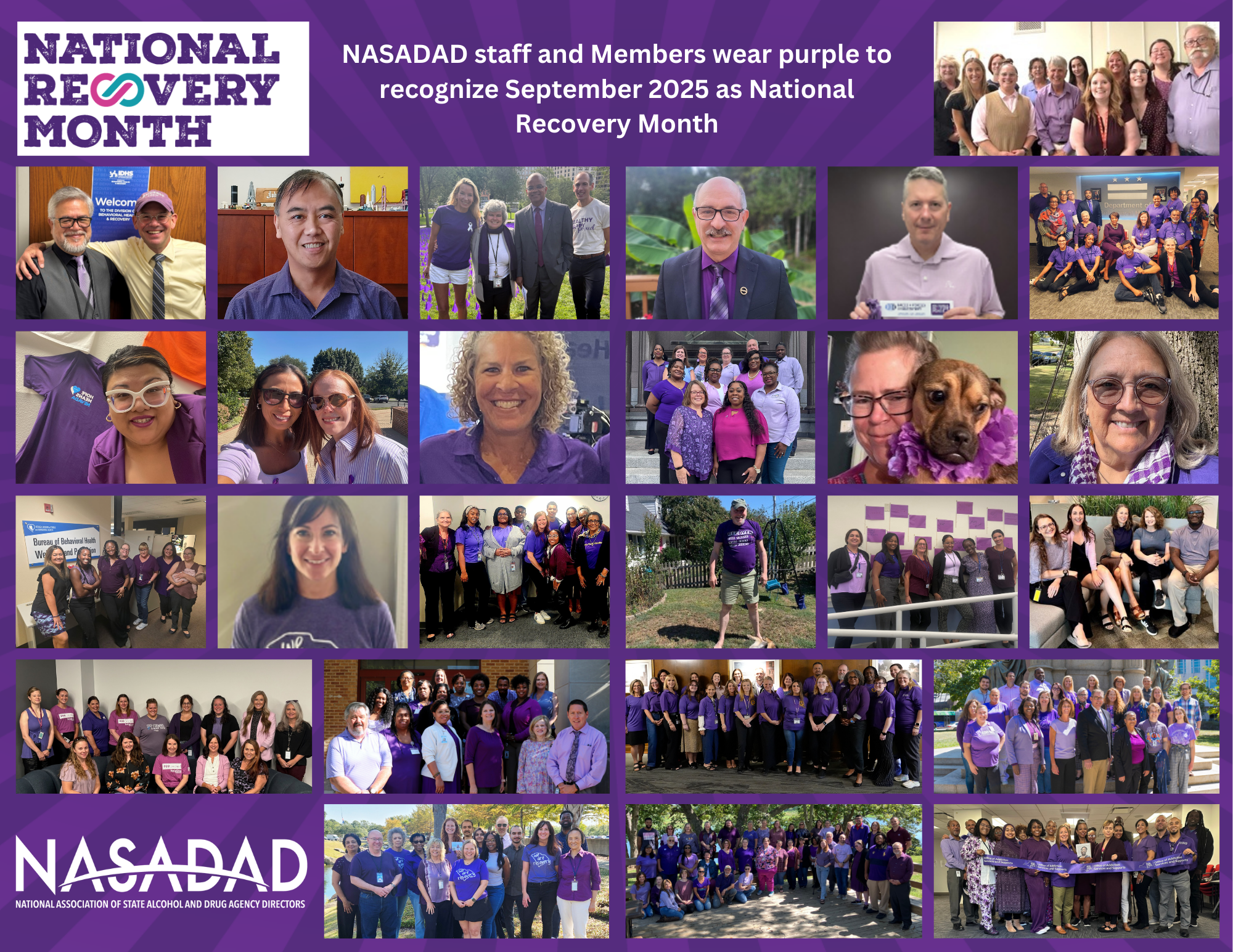
NASADAD 2025 National Recovery Month Collage
NASADAD is pleased to share the 2025 NASADAD National Recovery Month Collage!
National Recovery Month is an annual observance held each September dedicated to celebrating people in recovery from substance use disorder (SUD) and raising awareness for critical recovery support services. This year’s National Recovery Month theme is: Recovery is REAL (Restoring Every Aspect of Life). Through this theme, National Recovery Month seeks to elevate recovery support services and the effectiveness of SUD services to educate the public, stakeholders, and communities that recovery from SUD is real and possible for everyone.
NASADAD members are the lead agency in each State or jurisdiction responsible for managing the publicly funded substance use system across prevention, treatment, and recovery. This month, our staff and Members wear purple to celebrate recovery and promote awareness of SUD issues. NASADAD is grateful for the work all our members do in their States and jurisdictions to support recovery every day of the year.
Thank you to all who participated.
New State Opioid Response (SOR) Thematic Briefs
NASADAD has developed four new thematic briefs that highlight common strategies and services states have implemented for opioid and stimulant misuse and use disorders using SOR grant funding. These briefs describe state opioid overdose response programs, services for veterans, initiatives for young adults, and innovations across the justice and re-entry continuum. The documents are linked below.
Innovations Across the Justice and Re-entry Continuum
Opioid Overdose Response Programs
These briefs build upon NASADAD’s interactive map that describes the impact of the SOR grant across the country. It includes state and territorial-specific briefs that describe highlights of each state substance use agency’s use of SOR funds across the continuum of care. The interactive map is also available on NASADAD’s website: https://nasadad.org/opioid-state-targeted-response-map/
Impact of State Targeted Response & State Opioid Response Grants
NASADAD Develops Resource Document Summarizing Final Fiscal Year 2025 Funding for Federal Substance Use Disorder Programs
NASADAD has developed a comprehensive resource summarizing final Fiscal Year (FY) 2025 funding for key federal programs related to substance use disorders (SUD).
As you recall, Congress opted to pass a year-long continuing resolution (CR), as opposed to a traditional omnibus bill, that, in general, provided level funding for federal government agencies and programs for the remainder of FY 2025, which runs through September 30, 2025. President Donald Trump signed the CR, the Full-Year Continuing Appropriations and Extensions Act, 2025 (H.R.1968/P.L. 119-4), on March 15, 2025. This full-year CR included FY 2025 appropriations and a few provisions reauthorizing certain expiring SUD prevention, treatment, and recovery federal programs.
The document includes a chart that summarizes final FY 2025 funding for SUD programs housed within the following federal agencies:
- Department of Health and Human Services (HHS)
- Substance Abuse and Mental Health Services Administration (SAMHSA)
- Substance Use Prevention, Treatment, and Recovery Services (SUPTRS) Block Grant
- Center for Substance Abuse Treatment (CSAT)
- Center for Substance Abuse Prevention (CSAP)
- Center for Mental Health Services (CMHS)
- National Institute on Alcohol Abuse and Alcoholism (NIAAA)
- National Institute on Drug Abuse (NIDA)
- Centers for Disease Control and Prevention (CDC)
- Health Resources and Services Administration (HRSA)
- Administration for Children and Families (ACF)
- Substance Abuse and Mental Health Services Administration (SAMHSA)
- Department of Justice (DOJ)
- Office of National Drug Control Policy (ONDCP)
NASADAD Releases Updated Fact Sheet on SAMHSA’s Pregnant and Postpartum Women’s (PPW) Residential Program and State Pilot Program
Today, NASADAD is releasing an updated fact sheet, originally produced in 2021, and most recently updated in 2023, that provides an overview of the Substance Abuse and Mental Health Services Administration’ s (SAMHSA) Pregnant and Postpartum Women’s (PPW) Residential Program and State Pilot Program. The fact sheet “tells the story” behind the PPW Residential Services Program and the evolution of the PPW State Pilot Program- an initiative that NASADAD helped develop with Congress through the Comprehensive Addiction Treatment and Recovery Act (P.L. 114-198). This round of updates to the fact sheet includes the latest available outcomes data, recent grantees, and recent Congressional action related to both programs.